Moissanite has a cosmic discovery story, but the stone in a modern ring was not cut from a meteorite. Natural moissanite is extremely rare and usually too small for jewelry. Today’s gem-quality material is lab-created silicon carbide made possible by decades of scientific development.
History in one sentence
Henri Moissan identified natural silicon carbide in Canyon Diablo meteorite material in 1893; later scientists learned to grow larger crystals, making gem-quality moissanite jewelry commercially possible in the late twentieth century.
1893: Henri Moissan and Canyon Diablo
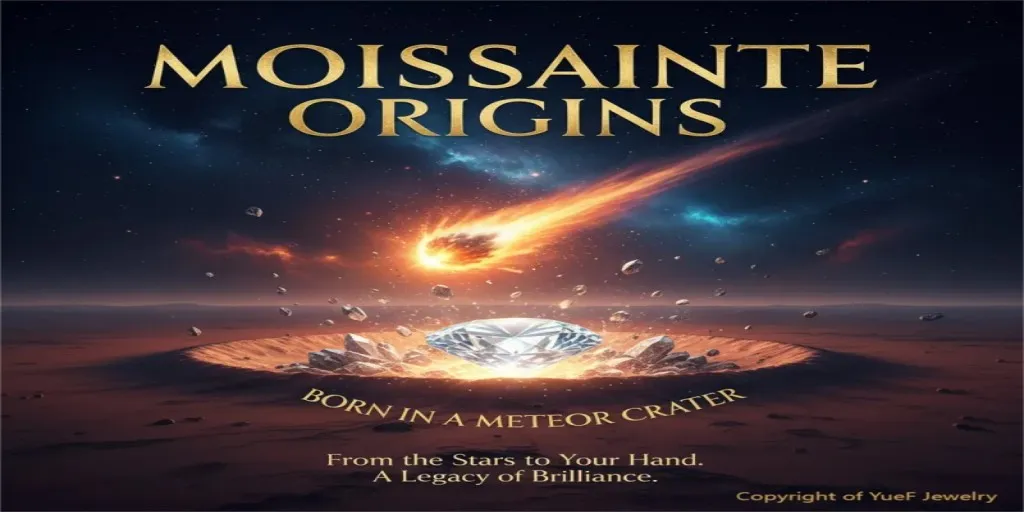
French chemist Henri Moissan examined mineral samples associated with the Canyon Diablo meteor crater in Arizona and found tiny crystals he initially considered diamond. Further analysis identified silicon carbide, a compound of silicon and carbon. The mineral was later named moissanite in his honor.
Moissan received the 1906 Nobel Prize in Chemistry for work involving the isolation of fluorine and the electric furnace, not specifically for discovering moissanite. Keeping those achievements separate makes the gemstone story more accurate.
Canyon Diablo in Arizona is associated with Henri Moissan’s identification of natural silicon carbide.
Why natural moissanite did not become a jewelry supply
Natural moissanite has since been reported in meteorites and some terrestrial geological settings, but crystals are exceptionally scarce and generally microscopic. There is no practical mine producing the large, transparent natural crystals required for a commercial jewelry market.
This distinction matters: a moissanite engagement ring can draw inspiration from a space-linked discovery without claiming that its center stone came from space.
Silicon carbide before gemstone jewelry
Scientists and industry learned to manufacture silicon carbide for abrasives, ceramics, electronics, and high-temperature applications. Producing small industrial crystals is different from growing large, clear, low-defect crystals suitable for cutting into gemstones.
Crystal-growth advances eventually made controlled gem material possible. Charles & Colvard introduced commercial jewelry moissanite in the late 1990s, helping establish the category for consumers.
Modern jewelry moissanite is grown under controlled laboratory conditions, then cut and polished.
Why moissanite works as a modern gemstone
HardnessAbout 9.25 on the Mohs scale, making it suitable for frequent wear with normal care.
Brilliance and fireA high refractive index and dispersion produce strong brightness and spectral flashes.
Lab-created supplyConsistent production makes jewelry sizes possible without relying on rare natural crystals.
Early moissanite could show more yellow or green tone. Continued material and cutting development expanded near-colorless options and shapes. The result is not a substitute that becomes diamond; it is a separate gemstone with a recognizable visual character.
A concise moissanite timeline
Frequently asked questions